

In Japan, a Scary Sharp Knife Is Just a Normal Knife
In Japan, kitchen knives are scary sharp. Not the chef's knives. The everyday ones. The knife in a tiny apartment kitchen. The beat-up one at the back of a noodle shop. The one a grandmother uses for breakfast.
A tomato does not get sliced there. It falls open. You set the edge on the skin, and the weight of the blade does the rest. Zero pressure.
And nobody in Japan thinks that is special. It is just what a knife is.
In America, we were never taught this. We were taught that knives go dull, and that dull is normal. So we press harder. We saw at the tomato. We hold it tighter and hope our fingers stay out of the way.
And when a knife gets bad enough, we buy a new one. Then another. Then a whole new set.
I did this for thirty years. I thought it was just how knives were.
It is not. The difference between an American kitchen and a Japanese one is not the knives. It is one small habit, and one small tool.
“I had a couple of knives which I wanted to throw out because no matter what I did, they were not knives anymore. I bought your knife sharpener, and all those knives are back to cutting tomatoes as if they are nothing.”
J.A., France · Verified buyer
A Sharp Knife Is Not Something You Buy. It Is Something You Keep.
Here is the habit.
In Japan, a home cook sharpens the knife the way we wipe down the cutting board. A few seconds, right at the counter, as part of cooking. Nobody takes a class. Nobody sends the knife away. Nobody buys a new one.
So the same ordinary knife stays scary sharp for years. Cheap knife, old knife, it makes no difference. The steel was never the point. The edge was.
In America we run it the other way. We cook on dull knives every day, and we replace them when they get bad enough. Then the slow slide starts again with the new one.
The tool that makes the Japanese habit possible is a rolling sharpener. It brings any knife back, sharper than a razor, in about thirty seconds, with no skill at all.
I had to try one. Here is what I found, and why it works when the usual fixes fail.
Make Every Knife You Own Japanese Sharp
A truly sharp knife needs zero pressure.
Tomatoes slice clean. Onions fall apart. Chicken cuts in one pass.
In Japan, every home kitchen cuts like this. Old knives. Cheap knives. All of them.
Not skill. Not better steel. Just one small tool.
| What matters | Hatori Roller | Others |
|---|---|---|
| Holds the angle for you | ✓ | ✗ |
| Zero skill needed | ✓ | ✗ |
| No water, no oil, no mess | ✓ | ✗ |
| About 30 seconds per knife | ✓ | ✗ |
| One tool, decades of use | ✓ | ✗ |
Why Your Knives Keep Going Dull (It's Not You)
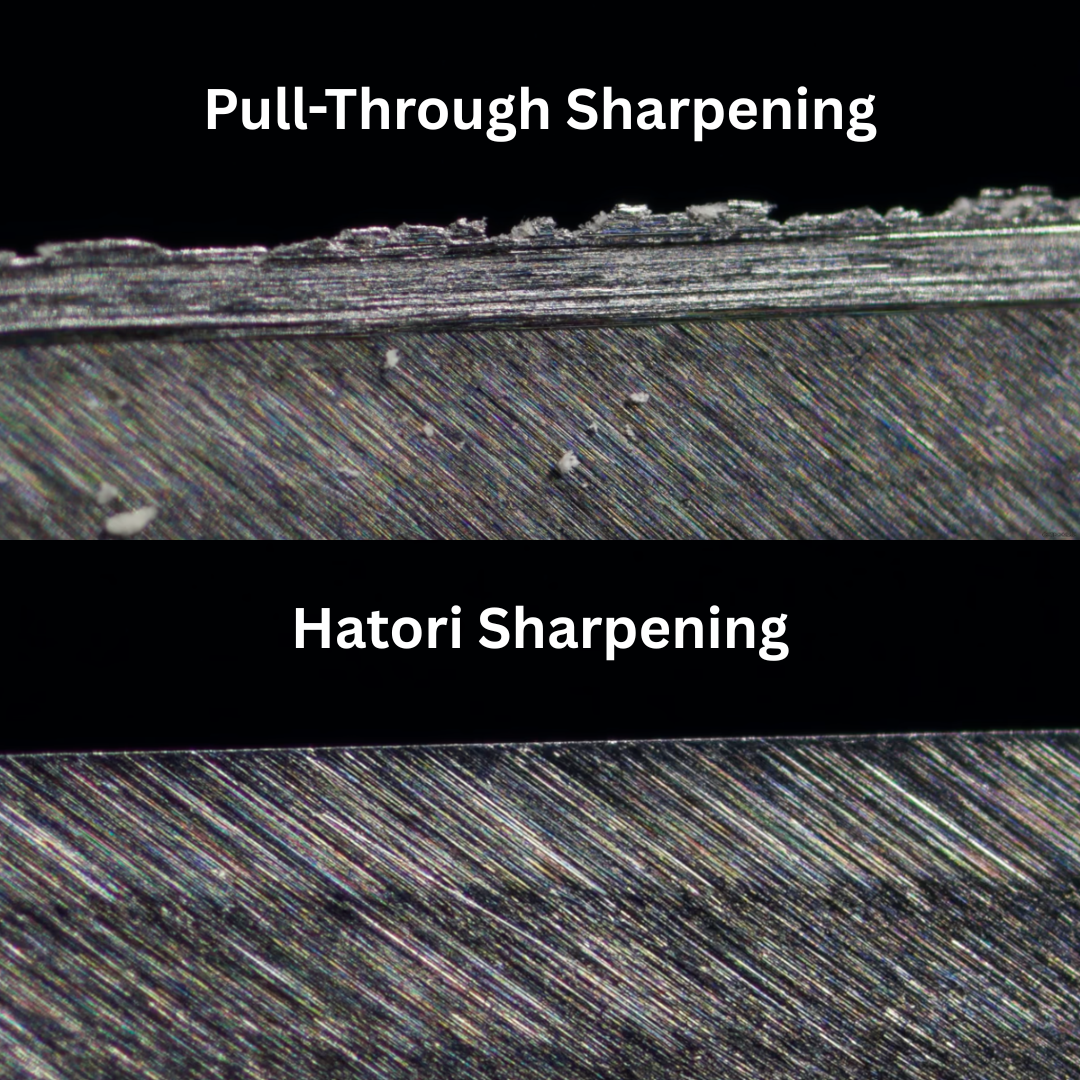
Most of us have tried something to bring a knife back. Here is what usually happens.
1. The $10 pull-through from the store.
You drag the knife through a little slot a few times. It rips steel off the edge in ragged strips. The knife feels sharp for a day or two. Then the torn edge folds over, duller than before.
2. The electric sharpener.
It is loud, and it eats steel fast. The spinning wheels heat up the thin edge. And it gives every knife the same angle, whatever kind of knife it is.
3. The whetstone.
A whetstone works, sure. But it's a real skill that takes years to learn. And it takes about twenty minutes per knife, bent over the sink.
4. Paying a sharpening service.
First you drive across town to drop the knives off. Then you spend a week cooking without them. By the time you remember to go back, they are dull again.
That is the gap. The quick fixes wreck the knife. The fix that works asks for an apprenticeship.
I wanted something in the middle. Fast, simple, and right every time.
The Part That Surprised Me: Sharpening Is Really About One Thing
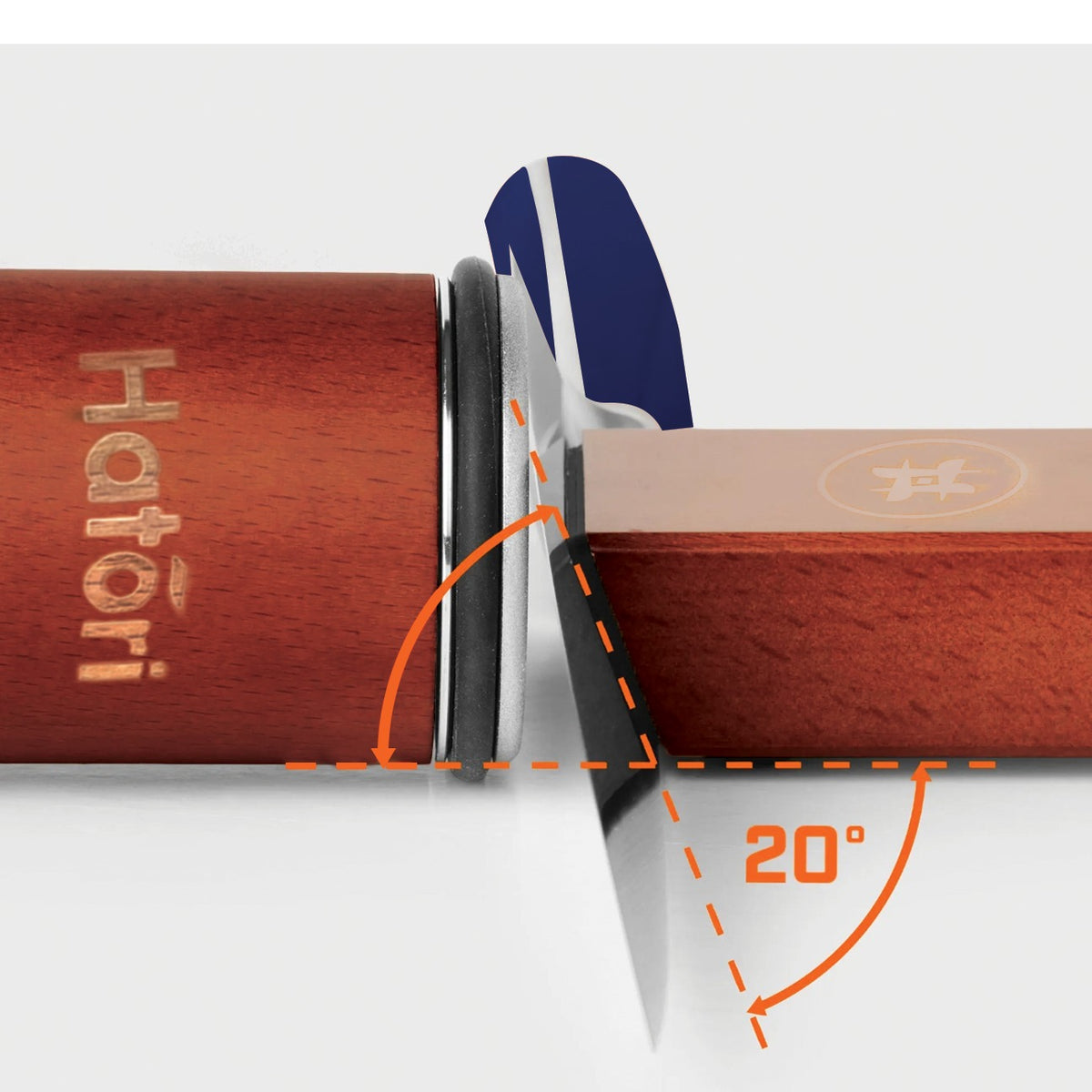
Before I tried it, I thought sharpening was about pressure. Or about strong, steady hands.
It is about angle.
Sharpening is really one job. Hold the blade at the exact same angle, stroke after stroke. Move a few degrees and the edge is undone. That is the part that takes professionals years to learn.
The tool I found does that part for you. It's called the Hatori Rolling Knife Sharpener. This is what Japanese home cooks use.
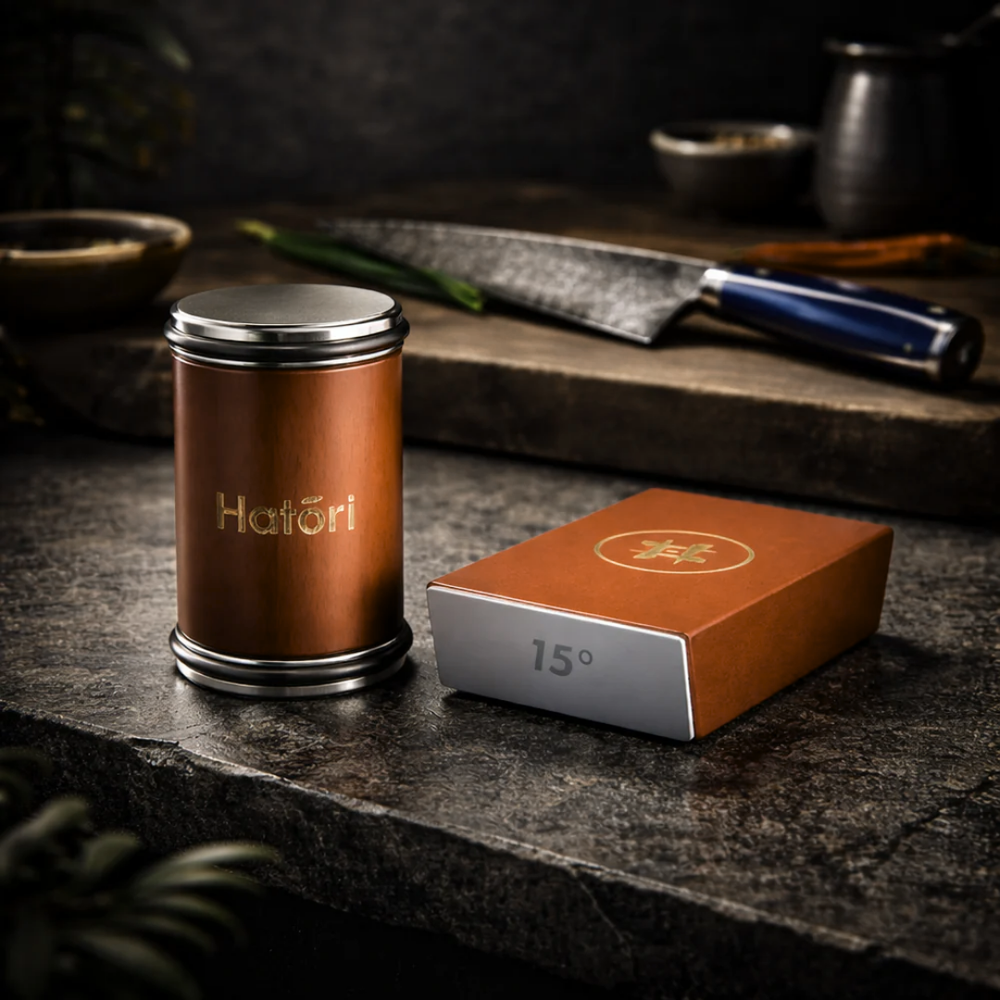
It comes in two pieces. A wooden base with magnets inside. And a wooden roller with a diamond disc on each end.
The magnets hold the angle for you.
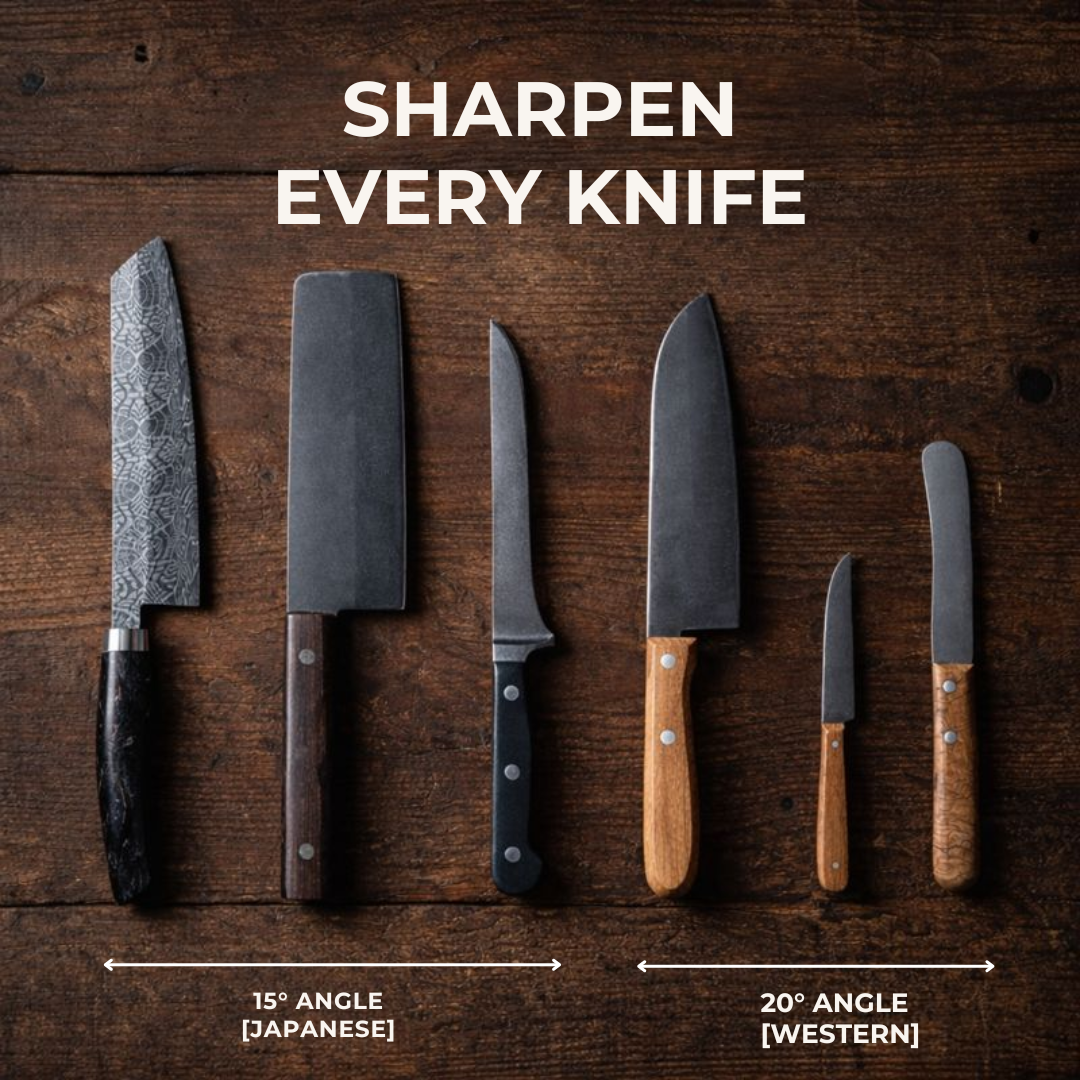
Your knife stands up against the base and locks in place. There are two settings. Use 15° for Japanese knives. Use 20° for Western knives. Not sure which you own? Use 20°.
Then you roll the sharpener along the knife. Back and forth, a few times. Flip the knife. Roll the other side. Done.
The angle stays the same on every single roll. You physically can't get it wrong.
The discs are coated in diamond.
It is lab grown, and it is the hardest material there is. Diamond cuts hardened knife steel about ten times faster than stone. That is why a knife takes about thirty seconds instead of half an hour at the sink.
One disc is coarse, 300 grit. It rebuilds a dull edge. The other is fine, 1000 grit. It polishes that edge razor fine. No water. No oil. No mess on the counter.
“I have struggled using a whetstone but this is so much easier and my knives are sharper than ever.”
William M., US · Verified buyer
I did every knife in my kitchen that first evening. Then I went looking for more tomatoes, just to slice them.
The Numbers Don't Lie
Think about what dull knives really cost over the years.
Most of us replace a knife every few years, or buy a whole new set. Some of us pay a service to sharpen them, then pay again a few months later. It adds up quietly.
- A new knife set$150 to $450
- A sharpening service$6 to $12 per knife, every time
- One Hatori rollerOne purchase. Every knife. For years.
Hatori sells direct from its own website, straight to your door. That is how readers of this page get it at 60% off.
I can shave with all my knives now! My neighbour, a chef, came round with his house knives. He's now bought one for work.
Reader offer
Get the Hatori roller at 60% off, plus free shipping
Skeptical is fair. Try it on the dullest knife you own. If the first slice does not convince you, send it back within 60 days for a full refund.
- 60% off for readers of this page
- Free shipping
- Ships within 24 hours
- 60-day money-back guarantee
One Small Tool for Every Knife in the House
- Chef's knife, santoku, paring, carving. If the edge is straight, the base holds it.
- About thirty seconds a knife, any evening you want.
- The magnets hold the angle, so every roll matches.
- Diamond discs. No water, no oil, no mess.
- Solid wood and steel, built to outlast the knives it sharpens.
- Sixty days to decide, with your own knives.
Every order ships within 24 hours and comes with a 60-day money-back guarantee. Rated 4.8 out of 5, across more than 25,000 orders shipped.
What Real Customers Say After the First Evening
As a former butcher for 35 years, I was looking for an alternative to sharpening my knives with a steel. This sharpener has exceeded my expectations. My knives are sharp and cut through meat like butter!
I'm a retired Chef and have a lot of knives, and am very pleased with the ease and excellent results. This is a very good improvement over the way I have been sharpening.
I started with three Cuisinart knives that were not sharp anymore. I tested them on garden tomatoes that were a little soft, and they sliced through them like a hot knife through butter! I was skeptical, but it worked out well.
My knives are over 15 years old. Professionally sharpened a couple of times. Results were OK. The Hatori was easy safe and the knives are like brand new.
I'm not a chef, I'm an old lady of almost 84 and I like my knives sharp. I found this equipment very easy to use and now my knives are nice and sharp. A quality product that I wish had been around years ago.
I've always used a whetstone and been pleased with the result. I didn't expect the Hatori to be better. It outperforms a whetstone, does so faster, without any possibility of making an error, and without mess.
Questions Readers Ask
Will it work on my cheap knives?
Yes. The magnet holds any straight-edged kitchen knife at a steady angle, and the diamond cuts fresh steel on the edge. Old knives, cheap knives, and the ones in the back of the drawer all come back.
Do I need to know what angle my knife is?
Use 15° for Japanese knives and 20° for Western knives. If you are not sure, use 20°. The magnet holds it there for you on every roll.
How often will I need to do it?
The first time on a long-dull knife takes the longest, because the coarse disc rebuilds the edge. After that, a few rolls on the fine disc keeps it sharp. When a tomato starts to drag, give it about thirty seconds.
Make Sharp Knives Normal at Home
In Japan a sharp knife is not a luxury. It is just a tool that gets kept up. The Hatori roller puts that within reach of any kitchen, in about thirty seconds a knife.
- About 30 seconds per knife
- 15° and 20° magnetic angle lock
- Diamond discs, no water or oil
- 60-day money-back guarantee
Hatori · 30 North Gould Street, Sheridan, WY 82801 · info@hatoriknives.com
This page is an advertisement for Hatori's own product, written by Hatori. Reviews are from verified customers. Results vary with the knife and its condition.